 Amazon.com Review
Amazon Best Books of the Month, January 2010: It’s back. With those words Tim and Jane Farnsworth reenter a nightmare they know so intimately it needs no other description. "It" may not be found among an insurance company’s diagnostic codes, but the Farnsworths, a couple made wealthy by Tim’s single-mindedly successful legal practice, know it too well: Tim’s compulsion, at any random moment of the day or night, to set out walking for hours at a time until he collapses in exhaustion. They’ve survived two bouts of this inexplicable illness, which began as mysteriously as they ended, and now, as Joshua Ferris’s second novel, The Unnamed, opens, they are beset by a third. Ferris’s first book, Then We Came to the End, was one of the freshest, most acclaimed fiction debuts of the decade, but he’s followed it not with an imitation or extension but with something thrillingly different. Like Tim possessed in one of his perambulatory vectors, Ferris follows his character’s condition as far as it leads him, far beyond where logic and loyalty usually take our lives, but always treats it with empathy, grace, and imagination. His language is as exact and poetic as his premise is fantastic, and by the story’s end you feel the title refers not only to his hero’s strange and solitary disease but also to those elemental but equally inexplicable forces that bind us together through the most difficult turns of our fated lives. --Tom Nissley
From Publishers Weekly
Starred Review. In Ferris’s remarkable second novel (after Then We Came to the End), a life of privilege comes to ruin as a result of a strange and mysterious illness. Attorney Tim Farnsworth thought he had recovered from a disorder that compels him to walk to the point of exhaustion. But now his walking disease has returned and shows no sign of going into remission. His wife, Jane, supportive beyond measure, does everything she can to keep Tim safe during his walks, including making routine midnight trips to pick him up. As the disorder takes increasing control over their lives, however, the sacrifices they make for each other drive them further apart. Ferris manages to inject a bizarre whimsy into a devastatingly sad story, with each of Tim’s outings revealing a new aspect of his marriage. The novel’s circular aspects, with would-be happy endings spiraling back into chaos and then descending further, integrate Ferris’s themes of family, sickness, and the uncertain division between body and mind into a vastly satisfying and original book. (Jan.)
Copyright © Reed Business Information, a division of Reed Elsevier Inc. All rights reserved.
Amazon.com Review
Amazon Best Books of the Month, January 2010: It’s back. With those words Tim and Jane Farnsworth reenter a nightmare they know so intimately it needs no other description. "It" may not be found among an insurance company’s diagnostic codes, but the Farnsworths, a couple made wealthy by Tim’s single-mindedly successful legal practice, know it too well: Tim’s compulsion, at any random moment of the day or night, to set out walking for hours at a time until he collapses in exhaustion. They’ve survived two bouts of this inexplicable illness, which began as mysteriously as they ended, and now, as Joshua Ferris’s second novel, The Unnamed, opens, they are beset by a third. Ferris’s first book, Then We Came to the End, was one of the freshest, most acclaimed fiction debuts of the decade, but he’s followed it not with an imitation or extension but with something thrillingly different. Like Tim possessed in one of his perambulatory vectors, Ferris follows his character’s condition as far as it leads him, far beyond where logic and loyalty usually take our lives, but always treats it with empathy, grace, and imagination. His language is as exact and poetic as his premise is fantastic, and by the story’s end you feel the title refers not only to his hero’s strange and solitary disease but also to those elemental but equally inexplicable forces that bind us together through the most difficult turns of our fated lives. --Tom Nissley
From Publishers Weekly
Starred Review. In Ferris’s remarkable second novel (after Then We Came to the End), a life of privilege comes to ruin as a result of a strange and mysterious illness. Attorney Tim Farnsworth thought he had recovered from a disorder that compels him to walk to the point of exhaustion. But now his walking disease has returned and shows no sign of going into remission. His wife, Jane, supportive beyond measure, does everything she can to keep Tim safe during his walks, including making routine midnight trips to pick him up. As the disorder takes increasing control over their lives, however, the sacrifices they make for each other drive them further apart. Ferris manages to inject a bizarre whimsy into a devastatingly sad story, with each of Tim’s outings revealing a new aspect of his marriage. The novel’s circular aspects, with would-be happy endings spiraling back into chaos and then descending further, integrate Ferris’s themes of family, sickness, and the uncertain division between body and mind into a vastly satisfying and original book. (Jan.)
Copyright © Reed Business Information, a division of Reed Elsevier Inc. All rights reserved. The Unnamed [Hardcover]
Amazon.com Review
Amazon Best Books of the Month, January 2010: It’s back. With those words Tim and Jane Farnsworth reenter a nightmare they know so intimately it needs no other description. "It" may not be found among an insurance company’s diagnostic codes, but the Farnsworths, a couple made wealthy by Tim’s single-mindedly successful legal practice, know it too well: Tim’s compulsion, at any random moment of the day or night, to set out walking for hours at a time until he collapses in exhaustion. They’ve survived two bouts of this inexplicable illness, which began as mysteriously as they ended, and now, as Joshua Ferris’s second novel, The Unnamed, opens, they are beset by a third. Ferris’s first book, Then We Came to the End, was one of the freshest, most acclaimed fiction debuts of the decade, but he’s followed it not with an imitation or extension but with something thrillingly different. Like Tim possessed in one of his perambulatory vectors, Ferris follows his character’s condition as far as it leads him, far beyond where logic and loyalty usually take our lives, but always treats it with empathy, grace, and imagination. His language is as exact and poetic as his premise is fantastic, and by the story’s end you feel the title refers not only to his hero’s strange and solitary disease but also to those elemental but equally inexplicable forces that bind us together through the most difficult turns of our fated lives. --Tom Nissley
From Publishers Weekly
Starred Review. In Ferris’s remarkable second novel (after Then We Came to the End), a life of privilege comes to ruin as a result of a strange and mysterious illness. Attorney Tim Farnsworth thought he had recovered from a disorder that compels him to walk to the point of exhaustion. But now his walking disease has returned and shows no sign of going into remission. His wife, Jane, supportive beyond measure, does everything she can to keep Tim safe during his walks, including making routine midnight trips to pick him up. As the disorder takes increasing control over their lives, however, the sacrifices they make for each other drive them further apart. Ferris manages to inject a bizarre whimsy into a devastatingly sad story, with each of Tim’s outings revealing a new aspect of his marriage. The novel’s circular aspects, with would-be happy endings spiraling back into chaos and then descending further, integrate Ferris’s themes of family, sickness, and the uncertain division between body and mind into a vastly satisfying and original book. (Jan.)
Copyright © Reed Business Information, a division of Reed Elsevier Inc. All rights reserved. 
Where the God of Love Hangs Out: Fiction [Hardcover]
 From Publishers Weekly Bloom’s latest collection (after novel Away) looks at love in many forms through a keenly perceptive lens. Two sets of stories that read much like novellas form the book’s soul; the first of which revolves around two couples-William and Isabel, Clare and Charles-and begins with Clare and William falling into an affair that endures divorces, remarriage and illness. Bloom has an unsettling insight into her character’s minds: Clare’s self-disgust is often reflected in her thoughts about William, demonstrating the complexity of their attraction as their comfort with each other grows, until she finally accepts the beauty of what they have-albeit too late. The second set of stories, featuring Lionel and Julia, is more complicated; the death of Lionel’s father propels Lionel and Julia together in a night of grief, remarkable (and icky) mostly because Julia is Lionel’s stepmother and his father’s widow. As years go by, it is unclear whether Lionel’s difficulties are due to that indiscretion, but watching Bloom work Lionel, Julia and her son through the rocky aftermath is a delight. The four stand-alone stories, while nice, have a hard time measuring up against the more immersive interlinked material, which, really, is quite sublime. (Jan.) Copyright © Reed Business Information, a division of Reed Elsevier Inc. All rights reserved. From Booklist After her best-selling historical novel Away (2007), Bloom returns to the form that made her famous, the short story. In her third collection, as in all of her books, love is the mysterious, gravitational force that rules her hapless, oddly noble characters. Of course, love is the theme of most fiction. What makes Bloom’s serrated stories so keen is her penetrating insights into the ambiguity, orneriness, confusion, and obsession that make expressions of love so ludicrous, treacherous, and profound. In the perfectly pitched title story, a woman comes clean about her past to her unfazed father-in-law, who harbors his own hidden desire. Bloom returns to a biracial family introduced in earlier works and brilliantly continues the highly charged saga of Julia and her stepson, Lionel. The best of this collection of bittersweet tales of psychic pain are about tender William and vinegary Clare, who, though on in years and married to fine spouses, can no longer ignore the fact that they are only completely at ease with each other. Bloom’s stories are emotionally precise, mordantly funny, and beautifully distilled. --Donna Seaman
 The Hand That First Held Mine [Hardcover]
 Amazon Best Books of the Month, April 2010: Maggie O’Farrell has a singular knack for sensing the magnetic fields that push and pull people in love, and in The Hand That First Held Mine, she summons those invisible forces to tell two stories. The first is the spirited journey of Lexie Sinclair, a bright, tempestuous woman who finds her way from rural Devon to the center of postwar London’s burgeoning art scene. Her force of personality makes her a natural critic (she’s a wonderful tour guide to Soho’s Bohemian circles), and she soon falls deeply in love. Fast forward fifty years and you’ll meet Ted and Elina: a contemporary London couple who’ve just had their first child, both afflicted with a crisis of memory--Elina can recall only bits and pieces of her life before the baby, while Ted fights off memories he can’t even recognize. O’Farrell alternates these plots artfully, always keeping the incorrigible Lexie in forward motion, while letting Ted and Elina wade further back in time. Inevitably, the two stories collide, and the result is a remarkably taut and unsentimental whole that embraces the unpredictable, both in love and in life. --Anne Bartholomew From Publishers Weekly O’Farrell (TheVanishing Act of Esme Lennox) interweaves two seemingly unconnected stories-that of Lexie Sinclair, living in post-WWII London, and Elina Vilkuna, a denizen of present-day London. Lexie is a rebellious 21-year-old, and when she meets handsome and sophisticated Innes Kent, she realizes he’s the one who can help her find the adventure and excitement she craves. Their affair coincides with her moving up in the ranks at the magazine he edits, but a tragedy changes Lexie’s life forever. Fifty-odd years later, Elina, a painter, faces her own struggles: she recently had a son with her boyfriend, Ted, and, after a rough child-birth, Ted and Elina struggle to recalibrate their relationship as it evolves into parenthood. While O’Farrell brings Lexie to life, she does not achieve the same with Elina and Ted, who come across as just another bland couple facing the challenges of having a child. The two plots are, naturally, connected, but the contemporary plot doesn’t really get moving until too late in the book. If the contemporary storyline was developed half as well as the historical plot, this would be a wonderful book. As it is, it feels lighter than it should. (Apr.) Copyright © Reed Business Information, a division of Reed Elsevier Inc. All rights reserved.
 Rock Paper Tiger [Hardcover]
 From Publishers Weekly Starred Review. Ellie Cooper, the heroine of Brackmann’s electrifying debut, is an Iraq War vet trying to forget her past while bumming around the fringes of the Beijing art world. Having been ditched by her husband, Trey, a former army interrogator now working in China as a private security consultant, Ellie has drifted into a relationship with the artist Lao Zhang, as well as into a fog of Percocet and ennui in order to escape her memories of Iraq. After Zhang disappears with a mysterious Uighur, Ellie becomes a person of interest to U.S. and Chinese authorities, and soon Ellie’s evading goons and cops, getting information from Zhang’s friends via a massive multiplayer online game, and flashing back to her experiences as a combat medic at an Abu Ghraib-like detention center. The China scenes are fast paced and strikingly atmospheric, and Ellie’s backstory-her and Trey’s return from combat is tough, sad, and endearing-is given in doses that perfectly complement the central action. Given the high-octane leadup, the ending is a bit of a letdown, but the book’s exotic setting and tough heroine will definitely appeal to fans of John Burdett and Stieg Larsson. (June) Copyright © Reed Business Information, a division of Reed Elsevier Inc. All rights reserved. From Booklist Brackmann’s debut deftly mixes modern China, the Iraq War, and online gaming, an unusual combination that manages to work. Iraq vet Ellie Cooper is making a new life for herself in Beijing, living with friends in an unsanctioned artists’ village on the outskirts of town. A chance encounter with an Uighur (Turkish ethnics living in China) sets in motion a baffling series of events in which Ellie is pursued by American and Chinese agents. Not sure whom to trust or where to turn, Ellie finds that she is able to communicate safely using a relatively unmonitored online role-playing game. Ellie’s story of her time in Iraq and the reasons she initially came to China are revealed in chapter-long flashbacks interspersed with the main story; taken together, the two narrated strands constitute a fast-paced and engaging story as both plots are full of mystery and suspense. Although the ending falls a bit flat, the tension up to that point is sustained superbly, and the characters are full-bodied and engaging. Good reading for anyone interested in the international crime novel. --Jessica Moyer
 The Ask: A Novel [Hardcover]
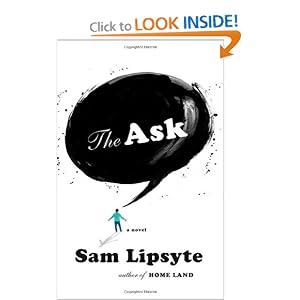 Amazon.com Review Amazon Best Books of the Month, March 2010: How can a life so miserable be so funny? Is it because the stakes are so low (Milo Burke, the antihero of Sam Lipsyte’s novel, The Ask, is a failure at many things, but most prominently at his job of pulling in major donors for a deadwater arts program at a middling university neither you nor he care about), or because they are so high (among them death, love, and the general squandering of the glories of creation on trivia)? Lipsyte’s brilliant bile earned his previous novel, Home Land, one of the most passionate cult followings in recent years, and in The Ask that verbal invention is often the only thing that can rouse Milo and his peers from their ennui. They bait and badger each other and toss off complex cultural analyses to little effect, all the while haunted by the gap between wit and wisdom. Lipsyte manages to be both sour and tender to his characters, Milo in particular, whose barest shambles toward self-respect come to seem like the first baby steps of an honorable quest. --Tom Nissley From Publishers Weekly Starred Review. Lipsyte’s pitch-black comedy takes aim at marriage, work, parenting, abject failure (the author’s signature soapbox) and a host of subjects you haven’t figured out how to feel bad about yet. This latest slice of mucked-up life follows Milo Burke, a washed-up painter living in Astoria, Queens, with his wife and three-year-old son, as he’s jerked in and out of employment at a mediocre university where Milo and his equally jaded cohorts solicit funding from the Asks, or those who financially support the art program. Milo’s latest target is Purdy Stuart, a former classmate turned nouveau aristocrat to whom Milo quickly becomes indentured. Purdy, it turns out, needs Milo to deliver payments to Purdy’s illegitimate son, a veteran of the Iraq War whose titanium legs are fodder for a disgruntlement that makes the chip on Milo’s shoulder a mere speck of dust by comparison. Submission is the order of the day, but where Home Land had a working-class trajectory, this takes its tone of lucid lament to the devastated white-collar sector; in its merciless assault on the duel between privilege and expectation, it arrives at a rare articulation of empire in decline. (Mar.) Copyright © Reed Business Information, a division of Reed Elsevier Inc. All rights reserved.
 Ship Breaker [Hardcover]
 From School Library Journal Grade 7 Up-A fast-paced postapocalyptic adventure set on the American Gulf Coast. Nailer works light crew; his dirty, dangerous job is to crawl deep into the wrecks of the ancient oil tankers that line the beach, scavenging copper wire and turning it over to his crew boss. After a brutal hurricane passes over, Nailer and his friend Pima stumble upon the wreck of a luxurious clipper ship. It’s filled with valuable goods-a "Lucky Strike" that could make them rich, if only they can find a safe way to cash it in. Amid the wreckage, a girl barely clings to life. If they help her, she tells them, she can show them a world of privilege that they have never known. But can they trust her? And if so, can they keep the girl safe from Nailer’s drug-addicted father? Exciting and sometimes violent, this book will appeal to older fans of Scott Westerfeld’s "Uglies" series (S & S) and similar action-oriented science fiction.-Hayden Bass, Seattle Public Library, WA Copyright © Reed Business Information, a division of Reed Elsevier Inc. All rights reserved. From Booklist *Starred Review* This YA debut by Bacigalupi, a rising star in adult science fiction, presents a dystopian future like so many YA sf novels. What is uncommon, though, is that although Bacigalupi’s future earth is brilliantly imagined and its genesis anchored in contemporary issues, it is secondary to the memorable characters. In a world in which society has stratified, fossil fuels have been consumed, and the seas have risen and drowned coastal cities, Nailer, 17, scavenges beached tankers for scrap metals on the Gulf Coast. Every day, he tries to “make quota” and avoid his violent, drug-addicted father. After he discovers a modern clipper ship washed up on the beach, Nailer thinks his fortune is made, but then he discovers a survivor trapped in the wreckage-the “swank” daughter of a shipping-company owner. Should he slit the girl’s throat and sell her for parts or take a chance and help her? Clearly respecting his audience, Bacigalupi skillfully integrates his world building into the compelling narrative, threading the backstory into the pulsing action. The characters are layered and complex, and their almost unthinkable actions and choices seem totally credible. Vivid, brutal, and thematically rich, this captivating title is sure to win teen fans for the award-winning Bacigalupi. Grades 8-12. --Lynn Rutan
 So Cold the River [Hardcover]
 Amazon.com Review Amazon Best Books of the Month, June 2010: Award-winning author Michael Koryta’s first foray into the supernatural genre is spellbinding and check-your-doors-and-windows scary, and it all begins with a check and a bottle of water. Filmmaker Eric Shaw had a knack for getting the exact right shot--an unexplained tug that unerringly put him on the right path--until his temper killed his Hollywood career. He gets a shot at redemption when a wealthy young woman commissions a video tribute for her father-in-law, a dying millionaire named Campbell Bradford. A man with a shady past, a town with a rich history, and an antique bottle of water claiming to "cure all ills" lead Shaw to small town West Baden, where things quickly go sideways. Shaw finds himself at odds with Bradford’s only surviving family, a bitter and violent great-grandson named Josiah, and that once familiar tug of Shaw’s becomes something darker and more dangerous. At its deliciously creepy core, So Cold the River is about two men facing down their demons, and what happens when those demons fight back. --Daphne Durham From Publishers Weekly Starred Review. In this explosive thriller from Koryta (Envy the Night), failed filmmaker Eric Shaw is eking out a living making family home videos when a client offers him big bucks to travel to the resort town of West Baden, Ind., the childhood home of her father-in-law, Campbell Bradford, to shoot a video history of his life. Almost immediately, things go weird. Eric uncovers evidence of another Campbell Bradford, a petty tyrant who lived a generation before the other and terrorized the locals. The older Campbell begins appearing in horrific visions to Eric after he sips the peculiar mineral water that made West Baden famous. Koryta spins a spellbinding tale of an unholy lust for power that reaches from beyond the grave and suspends disbelief through the believable interactions of fully developed characters. A cataclysmic finale will put readers in mind of some of the best recent works of supernatural horror, among which this book ranks. 6-city author tour. (June) Copyright © Reed Business Information, a division of Reed Elsevier Inc. All rights reserved.
Subscribe to:
Posts (Atom)