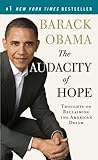
Amazon.com Review:
Barack Obama's first book, Dreams from My Father, was a compelling and moving memoir focusing on personal issues of race, identity, and community. With his second book The Audacity of Hope, Obama engages themes raised in his keynote speech at the 2004 Democratic National Convention, shares personal views on faith and values and offers a vision of the future that involves repairing a "political process that is broken" and restoring a government that has fallen out of touch with the people. We had the opportunity to ask Senator Obama a few questions about writing, reading, and politics--see his responses below. --Daphne Durham
Q: How did writing a book that you knew would be read so closely
by so many compare to writing your first book, when few people knew who
you were?
A: In many ways,
Dreams from My Father
was harder to write. At that point, I wasn't even sure that I could
write a book. And writing the first book really was a process of
self-discovery, since it touched on my family and my childhood in a
much more intimate way. On the other hand, writing
The Audacity of Hope
paralleled the work that I do every day--trying to give shape to all
the issues that we face as a country, and providing my own personal
stamp on them.
Q: What is your writing process like? You have such a busy schedule, how did you find time to write?
A:
I'm a night owl, so I usually wrote at night after my Senate day was
over, and after my family was asleep--from 9:30 p.m. or so until 1 a.m.
I would work off an outline--certain themes or stories that I wanted to
tell--and get them down in longhand on a yellow pad. Then I'd edit
while typing in what I'd written.
Q: If readers are to come away from
The Audacity of Hope with one action item (a New Year's Resolution for 2007, perhaps?), what should it be?
A:
Get involved in an issue that you're passionate about. It almost
doesn’t matter what it is--improving the school system, developing
strategies to wean ourselves off foreign oil, expanding health care for
kids. We give too much of our power away, to the professional
politicians, to the lobbyists, to cynicism. And our democracy suffers
as a result.
Q: You're known for being able to work with people across ideological lines. Is that possible in today's polarized Washington?
A:
It is possible. There are a lot of well-meaning people in both
political parties. Unfortunately, the political culture tends to
emphasize conflict, the media emphasizes conflict, and the structure of
our campaigns rewards the negative. I write about these obstacles in
chapter 4 of my book, "Politics." When you focus on solving problems
instead of scoring political points, and emphasize common sense over
ideology, you'd be surprised what can be accomplished. It also helps if
you're willing to give other people credit--something politicians have
a hard time doing sometimes.
Q: How do you make people passionate about moderate and complex ideas?
A:
I think the country recognizes that the challenges we face aren't
amenable to sound-bite solutions. People are looking for serious
solutions to complex problems. I don't think we need more moderation
per se--I think we should be bolder in promoting universal health care,
or dealing with global warming. We just need to understand that
actually solving these problems won't be easy, and that whatever
solutions we come up with will require consensus among groups with
divergent interests. That means everybody has to listen, and everybody
has to give a little. That's not easy to do.
Q: What has surprised you most about the way Washington works?
A: How little serious debate and deliberation takes place on the floor of the House or the Senate.
Q:
You talk about how we have a personal responsibility to educate our
children. What small thing can the average parent (or person) do to
help improve the educational system in America? What small thing can
make a big impact?
A: Nothing has a bigger impact than
reading to children early in life. Obviously we all have a personal
obligation to turn off the TV and read to our own children; but beyond
that, participating in a literacy program, working with parents who
themselves may have difficulty reading, helping their children with
their literacy skills, can make a huge difference in a child's life.
Q: Do you ever find time to read? What kinds of books do you try to make time for? What is on your nightstand now?
A:
Unfortunately, I had very little time to read while I was writing. I'm
trying to make up for lost time now. My tastes are pretty eclectic. I
just finished Marilynne Robinson’s
Gilead, a wonderful book. The language just shimmers. I've started
Team of Rivals
by Doris Kearns Goodwin, which is a great study of Lincoln as a
political strategist. I read just about anything by Toni Morrison, E.L.
Doctorow, or Philip Roth. And I've got a soft spot for John le Carre.
Q: What inspires you? How do you stay motivated?
A:
I'm inspired by the people I meet in my travels--hearing their stories,
seeing the hardships they overcome, their fundamental optimism and
decency. I'm inspired by the love people have for their children. And
I'm inspired by my own children, how full they make my heart. They make
me want to work to make the world a little bit better. And they make me
want to be a better man.
Product Description:“A government
that truly represents these Americans–that truly serves these
Americans–will require a different kind of politics. That politics will
need to reflect our lives as they are actually lived. It won’t be
pre-packaged, ready to pull off the shelf. It will have to be
constructed from the best of our traditions and will have to account
for the darker aspects of our past. We will need to understand just how
we got to this place, this land of warring factions and tribal hatreds.
And we’ll need to remind ourselves, despite all our differences, just
how much we share: common hopes, common dreams, a bond that will not
break.”
–from
The Audacity of HopeIn July 2004,
Barack Obama electrified the Democratic National Convention with an
address that spoke to Americans across the political spectrum. One
phrase in particular anchored itself in listeners’ minds, a reminder
that for all the discord and struggle to be found in our history as a
nation, we have always been guided by a dogged optimism in the future,
or what Senator Obama called “the audacity of hope.”
Now, in
The Audacity of Hope,
Senator Obama calls for a different brand of politics–a politics for
those weary of bitter partisanship and alienated by the “endless clash
of armies” we see in congress and on the campaign trail; a politics
rooted in the faith, inclusiveness, and nobility of spirit at the heart
of “our improbable experiment in democracy.” He explores those
forces–from the fear of losing to the perpetual need to raise money to
the power of the media–that can stifle even the best-intentioned
politician. He also writes, with surprising intimacy and
self-deprecating humor, about settling in as a senator, seeking to
balance the demands of public service and family life, and his own
deepening religious commitment.
At the heart of this book is
Senator Obama’s vision of how we can move beyond our divisions to
tackle concrete problems. He examines the growing economic insecurity
of American families, the racial and religious tensions within the body
politic, and the transnational threats–from terrorism to pandemic–that
gather beyond our shores. And he grapples with the role that faith
plays in a democracy–where it is vital and where it must never intrude.
Underlying his stories about family, friends, members of the Senate,
even the president, is a vigorous search for connection: the foundation
for a radically hopeful political consensus.
A senator and a
lawyer, a professor and a father, a Christian and a skeptic, and above
all a student of history and human nature, Senator Obama has written a
book of transforming power. Only by returning to the principles that
gave birth to our Constitution, he says, can Americans repair a
political process that is broken, and restore to working order a
government that has fallen dangerously out of touch with millions of
ordinary Americans. Those Americans are out there, he writes–“waiting
for Republicans and Democrats to catch up with them.”
someone say : I began reading this book at a friend's house and found it so
interesting that I immediately purchased it as an audiobook. However, I
quickly realized that I preferred the text version. Though much has
been made of Mr. Obama's incredible speaking skills (I think he even
won a Grammy for the audiobook), in my opinion, his words and writing
style are much better on the page. (Which is, perhaps, saying a lot?)
Other reviewers have covered the content of the book, so I won't
repeat their efforts here, except to say that Mr. Obama shows a clear
talent for (and refreshing respect for) thoughtful problem-assessment.
Though he offers few concrete solutions to the problems he discusses, I
do not think that's a negative, as it is clearly not his intention to
solve. After all, the book is not subtitled "How to Reclaim the
American Dream." Instead, his essays are presented as substantial
food-for-thought (and hopefully fuel for action).
The fact that so many reviewers have complained of the lack of
solutions just goes to show how desperately we want them, and how
important we think real solutions are. And yet every day, we perpetuate
a style of politics and political discourse that doesn't seem able to
produce those solutions. Mr. Obama's book reminds us that the solutions
we hope for are not going to magically come about unless we find a new
(or perhaps old?) way to talk about, and achieve, what we want.
The thesis of the book is not so much "we need to do this, this and
this!!" as it is "our problems are real but solvable-- if we can manage
to think clearly."
 Ever since Barack Obama was young, Hope has lived inside him. From the beaches of Hawaii to the streets of Chicago, from the jungles of Indonesia to the plains of Kenya, he has held on to Hope. Even as a boy, Barack knew he wasn't quite like anybody else, but through his journeys he found the ability to listen to Hope and become what he was meant to be: a bridge to bring people together.
 Of mixed race and cultures, Barack Obama struggled for years with his identity and place in society. Having found his niche in public service, he has made history as the fifth African American U.S. senator ever to be elected. Now “the skinny kid” continues his political journey and strives to become the nation’s first black president. From Hawaii to Chicago to Washington, D.C., Senator Obama’s life has been interesting and inspiring.
 The First Biographical Portrait Ever of This Key Political Figure
 At this defining moment in our history, Americans are hungry for change. After years of failed policies and failed politics from Washington, this is our chance to reclaim the American dream. Barack Obama has proven to be a new kind of leader–one who can bring people together, be honest about the challenges we face, and move this nation forward. Change We Can Believe In outlines his vision for America.
