Barack Obama: Son of Promise, Child of Hope

Ever since Barack Obama was young, Hope has lived inside him. From the beaches of Hawaii to the streets of Chicago, from the jungles of Indonesia to the plains of Kenya, he has held on to Hope. Even as a boy, Barack knew he wasn't quite like anybody else, but through his journeys he found the ability to listen to Hope and become what he was meant to be: a bridge to bring people together.

This is the moving story of an exceptional man, as told by Nikki Grimes and illustrated by Bryan Collier, both winners of the Coretta Scott King Award. Barack Obama has motivated Americans to believe with him, to believe that every one of us has the power to change ourselves and change our world.

someone said : I was so excited to see a picture book version of Obama's life, and knowing the work of Nikki Grimes, I ordered the title without hesitation. What I received was very disappointing. The narration was saccharine, almost to the point of being a story about someone whom I did not know. The Illustrations were also very disappointing.
I felt the book, overall, gave an unrealistic picture of a wonderful man, and was, ultimately, not suitable for young readers. I will wait for something better written and illustrated for this age group to come along.

A friend and I saw and went through this book in a store. We could not believe it. It portrays Obama as Messiah, Obama as deity. And the presentation is to children. Yep, the illustrations are, indeed, beautiful. The message: over-the-top brainwashing. Of children. This book represents the unquestioning society and hero worship. The book is beautiful, and sickening.

I was genuinely disturbed when I read on the Barack Obama website that the campaign was encouraging children to draw images of the senator to present as gifts to their parents and teachers, and moreso when I saw the suggestion that they bold 'Barack sleepovers.' These are tactics unworthy of a candidate in a Democratic system. But when I walked into Borders and saw this book on the display rack, my jaw, quite literally, dropped. And then, I just had to buy it.

I like to think of myself as a reasonable, rational person- not given to alarmism. I didn't vote for John Kerry, but I understand why many Americans were and are disaffected with President Bush. And his personal failings aside, Clinton did a fair job of reinventing the world after the collapse of the Cold War system.

Yet this, this is a travesty, a cult of personality rarely known to such grotesque degrees in American politics. The cover art should be titled 'The Apotheosis of Barack Obama'- a deification of man. God, yes, the literal God Almighty, speaks directly to the weeping titular character in this foul manipulation of children's literature, saying that the hope within him will last America throughout his life.

Playing on racial and class sympathies and the genuine ills these beleaguered communities face, and riddled with the fallacy of good intentions, this book offers up our friend Barack as a messiah-figure, a modern Moses leading the American people out of the wilderness.

There is no doubt that children ought to be educated about the political process, and should know something about the lives of the candidates. But this is not a life- it is a celebration, a glorification of a mythic figure who only exists in fairy tales. Perhaps that is why it works so well as a children's book- the cult of personality surrounding the glorious, the illustrious Senator Obama has generated perceptions of the man so outlandish that they can only be genuinely expressed in an illustrated fantasy.

I would say quite the same if John McCain supporters published something this disturbing- I have, indeed, said as much regarded the perverse adulation of President Bush by children in the well-known documentary 'Jesus Camp.' But the fact is, this book is a good and timely reflection of precisely what is wrong with American society- looking to the state and political leaders for salvation- and what is wrong with the kind of campaign Senator Obama is running.

...if it is, then this book manages to. I'm pretty neutral about Barack Obama as a person and a candidate, but the messianic message in this utterly insipid book makes me roll my eyes over and over again. The language is decent enough on a technical level for that age group, though patronizing. When he starts seeing the ghosts of JFK and MLK and references are made to Langston's Harlem, I'm not sure that the kids that the book is aimed at are going to pick up on the references. The illustrations are passable in the beginning, but as it continues, they become more and more over-the-top (Barack Obama crying in church, Barack Obama praying with a butterfly perched on his clasped hands, Barack Obama glowing with a heavenly aura). Cramming this political tripe into a children's book is bad enough, but the heavy-handed treatment and political sloganizing makes it unbearable.

Barack Obama: An American Story: An American Story (All Aboard Reading)

Of mixed race and cultures, Barack Obama struggled for years with his identity and place in society. Having found his niche in public service, he has made history as the fifth African American U.S. senator ever to be elected. Now “the skinny kid” continues his political journey and strives to become the nation’s first black president. From Hawaii to Chicago to Washington, D.C., Senator Obama’s life has been interesting and inspiring.

someone said : By older children, I mean the 6-8 crowd of the recommended ages 4-8. I think parts of this book are too advanced for even some kindergarteners, but it has great pictures and definitely enough information for an adult to paraphrase for the 4-5 year old child.

I bought this for my preschool to introduce the children to voting and presidents for upcoming election day. I won't be able to use this whole book verbetim, but definitely will use parts and paraphrase. I do think that a 1st grader will be able to understand it with an adult there to answer questions. Probably perfectly targeted towards the 2-3rd graders, not just for the language used, but for the concepts presented as well.

This is not a children's book. It is a work of propaganda. It should be titled, "How to Win Voters and Influence the Media By Playing the Race Card".
1. Obama's only real-world experience during his legal and political career is playing the race card. But for the race card, he would still be a lecturer at the University of Chicago Law School. He has no experience whatever as an executive, manager, or trial atorney. As president his total lack of executive experience would damage America the same way that Mayor Ray Nagin's lack of executive experience has damages New Orleand, But if anyone criticizes Obama, he, his wife, or his surrogates in the media (e.g. Chris Matthews and Andrea Mitchell) will play the race card.
2. Obama's sonorous voice and million dollar smile are not a substitute for his lack of judgment. His decisions on almost every political, economic and social issue have been wrong, and have caused him to lip-flop. He lacks the gravitas required of a president.
3. Obama's so-called policies are jive talk. Like Hitler, he is a charismatic speaker. Like Hitler, he believes that he is the messiah. But like Hitler, he has refused to articulate the "changes" that his political, economic and social policies will cause to America . There is no evidence to support his apocryphal claims. One recent example of his jive talk is his position on the military. Although he has consistently voted against the military, he argued to the VFW that he was pro-military because his relatives had served in the military! Only Democrats can accept the "logic" of his
argument.
4. Obama is a de jure but not a de facto American. He grew up in the alien and exotic cultures in both Hawaiiand Indonesia. After law school, he worked in the hate-filled neighborhoods of South Chicago. As Mark Penn, Hillary's strategist, said, he does not have "roots in America". He does not share our values and culture. His anti-American conduct speaks louder than his pro-American words. The disconnect between his words and actions is like that of his colleague John Edwards who's love affair with a TV producer contradicted hisrhetoric on marital fidelity and family values.
5. Like Stokely Carmichael and H. Rap Brown, Obama is a black separatist. For 20 years, he and his wife approved and supported the hate-speech and hate-ideas of Rev. Wright. Although he is bi-racial, he has chosen to align himself with the Black Establishment and the Congressional Black Caucus. If elected president, he will protect their interests, not the nation's interests. The undisputed evidence supports these claims of his racial animus. First, during the primaries he threw his white grandmother under the bus during the debate about race. If elected, he will do the same to white Ameriica. Second, even now he and his campaign are working to register black voters, but not white voters. How could a man who acts like that unite all Americans?
6. Obama's wife Michelle is an open and notorious anti-American. She speaks and acts as if she was the wife of Venezuela's President Hugo Chavez. She has spent her academic and professional life scorning American values and culture. Her senior thesis proves that she eschewes American values.Even though she is a graduate of Princeton and Harvard Law School, and is campaigning for her husband, Obama has made veiled threats to send "boz from the hood" to beat up anyone who dares to criticizes Michelle.
7. The Democrat's lust for the presidency is so great that they are willing to wink at Obama lack of qualification to be President of the United States and Commander in Chief of our armed forces. Like the German industrialists in 1930s Germany who thought that they could control Hitler, they think that in 21st
Century America that they can control Obama. They are wrong. Only Democrats would put their party's interests ahead of the nation's interests, and place our nuclear arsenal in the hands of an unqualified and untested person like Obama.
8. Independent voters should read this book in conjunction with two other books: Obama Nation and The Case Against Barack Obama. They should weigh the evidence. Then they should decide whether they and the nation should assume the risking of electing as president a person like Obama who is not "of the people, by the people, or for the people".

Hopes and Dreams: The Story of Barack Obama

The First Biographical Portrait Ever of This Key Political Figure

Written by a leading journalist and filled with more than 100 color photographs, this authoritative and up-to-the-moment new biography provides much-needed perspective on one of the most important figures on the national political stage.

An lively overview of Obama’s life, this timely book begins with his difficult childhood as the son of a Kansas-born college student and a black Kenyan who abandoned the family, moving through his election to president of the Harvard Law Review (the first black student ever), his early political career (including his loss of a congressional race in 2000), his own family life with wife Michelle and two daughters, his 2004 election to U.S. Senator, and his emergence as a symbol of hope for America. Including his own words and comments from both his critics and supporters, Hopes and Dreams is essential reading for all those interested in the man who is being talked about as a candidate for our highest office.

No political figure in recent memory has generated the interest that Obama has, and many compare his appeal to that of a rock star. Only forty-five years old, Barack Obama is certain to play an important role in America’s future. Here is his inspiring story to date, in words and revealing images.

someone said :
I am currently reading "The Audacity of Hope" and ordered this one more as a coffee table book. I also ordered this one because my husband who is working 50 hours plus a week and going to school part time doesn't have time to read more on Obama that he would like to. This book is perfect for those who are short on time but would like to find out more about Obama. The pictures are wonderful and the story is just as good ... it is more of an outline than an actual book, but it's inspiring, full of tales, quotes and a lot of it can be found in "The Audacity of Hope," which does go in more details about Obama and his vision for the future.

There is also a brief autiobiography about Obama, his struggles as a teenager and as a young adult, campaigning all over the state of Illnois where often there would only be a few people gathered together to hear him speak. In spite of the odds, he never gave up. He never gave up his hope and vision for a united America and that alone is his charm. After watching the presidential debates on TV and watching him speak at the Democratic National Convention, not only is he charming, it is evident that he is a hard-working man willing to work with both sides of the aisle to get things done. He is not your typical politician where fighting and the backlashing is the norm. He disagrees with that philosophy and for the first time since I can remember, he is the politican that I would love to see more of.

This book is just a reflection of that desire and there is an updated version of this book which I am tempted to get for my kids' sake. Whatever people may think of Obama, reading his books and hearing him speak ... he is definitely the man of the times.

Die Biographie spiegelt das Leben des angehenden amerikanischen Präsidentens Barack Obama in Form von Bildern, Textpassagen und Zitaten wider.
Der Autor Steve Dougherty hat ein Gespür für typische Aussagen Barack Obamas. In der Kombination von Zitaten wie z.B. "Erst, wenn man sich auf etwas Größeres vorbereitet, als man sich zutraut, begreift man sein wahres Potential" mit faszinierenden Bildern eines ergreifenden Lebens ergibt sich ein informativer Bildband. Bilder aus der Jugendzeit, dem Familienleben, der Studentenzeit, den politischen Lehrjahren, Anfängen des Wahlkampfes bis hin zur Präsidentschaft zeichnen eine ganzheitlich Sichtweise auf den Lebenslauf des Kanditaten. Die Fotoredaktion Hal Buells bewegt sich auf Augenhöhe mit den Textbeiträgen und Zitaten.
Es entsteht der Eindruck, als seien Autor und Fotografen stete Begleiter Barack Obamas gewesen. Dieser Bildband ist herzergreifend. Er wird all jene begeistern, die Sympathien für den Präsidenten hegen. Hoffnung und Träume gehören zu den Schlüsselwörtern des neuen Präsidenten der USA. Diese Biographie veranschaulicht, wie Träume wahr werden und Hoffnung so gelebt wird, dass sie weltweit Menschen inspiriert.

Change We Can Believe In: Barack Obama's Plan to Renew America's Promise

At this defining moment in our history, Americans are hungry for change. After years of failed policies and failed politics from Washington, this is our chance to reclaim the American dream. Barack Obama has proven to be a new kind of leader–one who can bring people together, be honest about the challenges we face, and move this nation forward. Change We Can Believe In outlines his vision for America.
 
In these pages you will find bold and specific ideas about how to fix our ailing economy and strengthen the middle class, make health care affordable for all, achieve energy independence, and keep America safe in a dangerous world. Change We Can Believe In asks you not just to believe in Barack Obama’s ability to bring change to Washington, it asks you to believe in yours.

someone say :
The book is a fine recapitulation of all the promises of Barack Obama throughout his campaign together with his speeches. Performing on those promises is substantially different. The last couple of elections our country has been divided almost 50/50. This election was very close. Over a 100 million people voted and Barack only won by about 3 million votes. That's amazing since nearly all black voters went to the polls for Barack. What's even more amazing is that after the election the media went into jubilation over the first black person to be elected president and neglected the fact that Barack's mother is white. Whoops. President Obama will be the first American president who is partly of African descent. Let's not change the facts.

It is a moot point now after the election ... I've voted and Obama's the next president. I just wish I had read this book earlier since it would have helped bolster my arguments with neighbors and friends regarding Obama's plan of action for the next four years. I finished this book in one day which, lately, is unusual for me as I am hitting a reading slump.

The first half of the book is a summary of the issues Obama would like to address once he is in office. He addresses the issues of global warming, education, women's rights, family planning, the war in Iraq, job security, health care, taxes and more (all issues that are dear to most Americans). I've followed his debates closely and tried to do all the research is necessary in making my decision on whom to vote and this book is a simplified guide to the issues and instead of lamenting what is wrong with our country, Obama is providing a course of action on what he would like to see happen. This is a non-partisanship book, which I really appreciate. There's no back-stabbing, no finger jabs at the previous adminstration and etc. It is just a straight-forward course of action ... if everyone in Congress will work together.

The second half of the book is his seven speeches and I will be the first to admit that listening to Obama speaking is a treasure ... wish I had the opportunity to hear him speak in person when he was in the area. Reading his speeches is almost just as good. He is an eloquent speaker and the compassion he holds for his fellow countrymen/women is evident in his speeches as well in the written word. If people still have doubts about Obama, this book is a good place to start reading. It may not be Pultizer Prize winning but it is a very good book and a start to get more information on what the Obama administration wants to have for the next four years.

Throughout his plan and his speeches, Obama has been consistent about one thing. He challenges Americans of all stages in life to work together. He challenges Americans to fight back and regain their lost dreams/hopes and he provides hope for the people. I will admit that he is the first politican who is inspiring. I've seen how many people turn off their TV sets and canvass the streets to provide a way for the people to vote. This is the first campaign where people are active in talking and sharing about their beliefs and how they would like to see things change. Obama has provided inspiration and hope for the people and it's evident in this book as well.

Dreams from My Father: A Story of Race and Inheritance

Product Description:
The son of a black African father and a white American mother, Obama was only two years old when his father walked out on the family. Many years later, Obama receives a phone call from Nairobi: his father is dead. This sudden news inspires an emotional odyssey for Obama, determined to learn the truth of his father's life and reconcile his divided inheritance. Written at the age of thirty-three, "Dreams from my Father" is an unforgettable read. It illuminates not only Obama's journey, but also our universal desire to understand our history, and what makes us the people we are.

someone say :
Of all the books that deserve ALL multiple formats, it is this one! There needs to be a cassette tape version that is unabridged. There needs to be a cassette version that is abridged. There needs to be a CD version that is unabridged. Any version that would increase access to the reading public to this book should be done. Please, please, please, publishers, yes, there is a market!!!!

Now that Obama's election has brought worldwide euphoria and made him the world's most famous man, his memoir is bound to become a lightning rod for cynics and dreamers alike. I suggest reading the book instead as an insight into the man he was becoming a dozen years ago. And whatever he might be today -- overburdened by a world of hope he can't possibly satisfy, and overhyped by our hunger for anyone but our current president -- he has written a remarkable book. Before we even knew his name, he was becoming Barack Obama, a sensitive, troubled searcher with an eloquent gift for crafting a story, collapsing time in narrative, and capturing a scene. I read "Dreams From My Father" hoping to understand our next president. I got far more out of it, coming to understand the duality of race in America, the struggles of sons and fathers, and the interconnectedness of cultures across oceans and centuries. We'll doubtless be saturated in the coming months and years with Obama this Obama that. That makes it all the more essential to read Obama before he became burdened by his own audacious hope. Don't take my word for it, or any other reviewer's, whether they consider Obama a monster or a god. Read about the man in the process of becoming a man.

This book has received a lot of scrutiny from Obama's detractors since he ran for president. It has also disappointed a lot of his fans.

This was written when Obama was much younger than he is now, so it should be read as a memoir about a reflection on family, race, identity. The book was clearly written by a man who knew he was going to go into politics, so it is not without its agenda. Despite this agenda (which is not overbearing), it still reads more like an honest self-reflection from a man starting to make his mark on the world. The honesty is unparalleled by any biography of an American politician I can think of (please tell me if I'm wrong) and that is very refreshing.

Those looking for any sort of insight into his policy ideas while president can use some inductive reasoning to fill out what ever they want (He's a socialist! He wants to cut taxes! He wants to raise taxes.) This should be avoided because his views since this book have changed on a lot of things. What you can see is how astute his observations are about a wide variety of people gained from his consistent outsider status. Given that he was relatively young when he penned this, one can only assume he has only matured farther.

Problems include some muddled prose when he tries to "out eloquence" himself (a criticism he admits in the preface to a newer addition), a lack of a family tree (it is a book about family), and about a fifty extra pages.

If you read this book for non-political reasons, you will enjoy most of his prose, observations on Americans, and honesty about himself: a young man of unusual origins struggling with an identity and lack of a father figure.) I would recommend reading it like this instead of digging for out-of-context snippets to further your preconceived notions of him (Messiah, drug-abuser, communist, racist, best politician ever, etc.)

I bought this book because I wanted to learn more about Obama before the election. It was well-written and interesting. Also, because it was written before he became a politician, I expected it to be more honest than his other book, "Audacity of Hope," which I have no intention of reading.

What is scary about it, though, is that he is very honest about how he came to reject his White heritage and embrace a kind of Black nationalism and racial separatism. (He certainly doesn't sound like that when he is on the campaign trail.)

Despite the fact that he doesn't experience much in the way of discrimination growing up, the turning point for him is when he goes to a "Black" party with some White friends, and the White friends soon leave, apparently because they were uncomfortable around a large group of Blacks. Obama is greatly offended by this and that seems to be when he "breaks" from his part-White identity.

What really shocked me was when he explained his opposition to inter-racial marriage. I'm Asian and my husband is White. I found it hard to believe that, being a product of a mixed marriage himself, Obama could have such views. He dated a White woman who loves him but he is against marrying her just because she is White. He explains that he doesn't want his children to be raised into "White American culture." You would think that Obama's own experience shows that children of mixed marriages do not necessarily assimilate into the culture of the White side. I find my marriage more interesting because of my and my husband's different ethnic backgrounds. Our children are being raised with an awareness of both their American and Chinese heritage, and there should have been no reason why Obama couldn't have raised his children in a similar fashion with a White wife.

I really got a picture of a man who was raised by Whites but who rejects them in favor of his African heritage, despite the fact that his African father essentially abandons him.

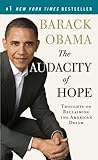
Books : The Audacity of Hope: Thoughts on Reclaiming the American Dream (Vintage)

Amazon.com Review:
Barack Obama's first book, Dreams from My Father, was a compelling and moving memoir focusing on personal issues of race, identity, and community. With his second book The Audacity of Hope, Obama engages themes raised in his keynote speech at the 2004 Democratic National Convention, shares personal views on faith and values and offers a vision of the future that involves repairing a "political process that is broken" and restoring a government that has fallen out of touch with the people. We had the opportunity to ask Senator Obama a few questions about writing, reading, and politics--see his responses below. --Daphne Durham

Q: How did writing a book that you knew would be read so closely by so many compare to writing your first book, when few people knew who you were?
A: In many ways, Dreams from My Father was harder to write. At that point, I wasn't even sure that I could write a book. And writing the first book really was a process of self-discovery, since it touched on my family and my childhood in a much more intimate way. On the other hand, writing The Audacity of Hope paralleled the work that I do every day--trying to give shape to all the issues that we face as a country, and providing my own personal stamp on them.

Q: What is your writing process like? You have such a busy schedule, how did you find time to write?
A: I'm a night owl, so I usually wrote at night after my Senate day was over, and after my family was asleep--from 9:30 p.m. or so until 1 a.m. I would work off an outline--certain themes or stories that I wanted to tell--and get them down in longhand on a yellow pad. Then I'd edit while typing in what I'd written.

Q: If readers are to come away from The Audacity of Hope with one action item (a New Year's Resolution for 2007, perhaps?), what should it be?
A: Get involved in an issue that you're passionate about. It almost doesn’t matter what it is--improving the school system, developing strategies to wean ourselves off foreign oil, expanding health care for kids. We give too much of our power away, to the professional politicians, to the lobbyists, to cynicism. And our democracy suffers as a result.

Q: You're known for being able to work with people across ideological lines. Is that possible in today's polarized Washington?
A: It is possible. There are a lot of well-meaning people in both political parties. Unfortunately, the political culture tends to emphasize conflict, the media emphasizes conflict, and the structure of our campaigns rewards the negative. I write about these obstacles in chapter 4 of my book, "Politics." When you focus on solving problems instead of scoring political points, and emphasize common sense over ideology, you'd be surprised what can be accomplished. It also helps if you're willing to give other people credit--something politicians have a hard time doing sometimes.

Q: How do you make people passionate about moderate and complex ideas?
A: I think the country recognizes that the challenges we face aren't amenable to sound-bite solutions. People are looking for serious solutions to complex problems. I don't think we need more moderation per se--I think we should be bolder in promoting universal health care, or dealing with global warming. We just need to understand that actually solving these problems won't be easy, and that whatever solutions we come up with will require consensus among groups with divergent interests. That means everybody has to listen, and everybody has to give a little. That's not easy to do.

Q: What has surprised you most about the way Washington works?
A: How little serious debate and deliberation takes place on the floor of the House or the Senate.

Q: You talk about how we have a personal responsibility to educate our children. What small thing can the average parent (or person) do to help improve the educational system in America? What small thing can make a big impact?
A: Nothing has a bigger impact than reading to children early in life. Obviously we all have a personal obligation to turn off the TV and read to our own children; but beyond that, participating in a literacy program, working with parents who themselves may have difficulty reading, helping their children with their literacy skills, can make a huge difference in a child's life.

Q: Do you ever find time to read? What kinds of books do you try to make time for? What is on your nightstand now?
A: Unfortunately, I had very little time to read while I was writing. I'm trying to make up for lost time now. My tastes are pretty eclectic. I just finished Marilynne Robinson’s Gilead, a wonderful book. The language just shimmers. I've started Team of Rivals by Doris Kearns Goodwin, which is a great study of Lincoln as a political strategist. I read just about anything by Toni Morrison, E.L. Doctorow, or Philip Roth. And I've got a soft spot for John le Carre.

Q: What inspires you? How do you stay motivated?
A: I'm inspired by the people I meet in my travels--hearing their stories, seeing the hardships they overcome, their fundamental optimism and decency. I'm inspired by the love people have for their children. And I'm inspired by my own children, how full they make my heart. They make me want to work to make the world a little bit better. And they make me want to be a better man.

Product Description:
“A government that truly represents these Americans–that truly serves these Americans–will require a different kind of politics. That politics will need to reflect our lives as they are actually lived. It won’t be pre-packaged, ready to pull off the shelf. It will have to be constructed from the best of our traditions and will have to account for the darker aspects of our past. We will need to understand just how we got to this place, this land of warring factions and tribal hatreds. And we’ll need to remind ourselves, despite all our differences, just how much we share: common hopes, common dreams, a bond that will not break.”
–from The Audacity of Hope


In July 2004, Barack Obama electrified the Democratic National Convention with an address that spoke to Americans across the political spectrum. One phrase in particular anchored itself in listeners’ minds, a reminder that for all the discord and struggle to be found in our history as a nation, we have always been guided by a dogged optimism in the future, or what Senator Obama called “the audacity of hope.”

Now, in The Audacity of Hope, Senator Obama calls for a different brand of politics–a politics for those weary of bitter partisanship and alienated by the “endless clash of armies” we see in congress and on the campaign trail; a politics rooted in the faith, inclusiveness, and nobility of spirit at the heart of “our improbable experiment in democracy.” He explores those forces–from the fear of losing to the perpetual need to raise money to the power of the media–that can stifle even the best-intentioned politician. He also writes, with surprising intimacy and self-deprecating humor, about settling in as a senator, seeking to balance the demands of public service and family life, and his own deepening religious commitment.

At the heart of this book is Senator Obama’s vision of how we can move beyond our divisions to tackle concrete problems. He examines the growing economic insecurity of American families, the racial and religious tensions within the body politic, and the transnational threats–from terrorism to pandemic–that gather beyond our shores. And he grapples with the role that faith plays in a democracy–where it is vital and where it must never intrude. Underlying his stories about family, friends, members of the Senate, even the president, is a vigorous search for connection: the foundation for a radically hopeful political consensus.

A senator and a lawyer, a professor and a father, a Christian and a skeptic, and above all a student of history and human nature, Senator Obama has written a book of transforming power. Only by returning to the principles that gave birth to our Constitution, he says, can Americans repair a political process that is broken, and restore to working order a government that has fallen dangerously out of touch with millions of ordinary Americans. Those Americans are out there, he writes–“waiting for Republicans and Democrats to catch up with them.”

someone say : I began reading this book at a friend's house and found it so interesting that I immediately purchased it as an audiobook. However, I quickly realized that I preferred the text version. Though much has been made of Mr. Obama's incredible speaking skills (I think he even won a Grammy for the audiobook), in my opinion, his words and writing style are much better on the page. (Which is, perhaps, saying a lot?)

Other reviewers have covered the content of the book, so I won't repeat their efforts here, except to say that Mr. Obama shows a clear talent for (and refreshing respect for) thoughtful problem-assessment. Though he offers few concrete solutions to the problems he discusses, I do not think that's a negative, as it is clearly not his intention to solve. After all, the book is not subtitled "How to Reclaim the American Dream." Instead, his essays are presented as substantial food-for-thought (and hopefully fuel for action).

The fact that so many reviewers have complained of the lack of solutions just goes to show how desperately we want them, and how important we think real solutions are. And yet every day, we perpetuate a style of politics and political discourse that doesn't seem able to produce those solutions. Mr. Obama's book reminds us that the solutions we hope for are not going to magically come about unless we find a new (or perhaps old?) way to talk about, and achieve, what we want.

The thesis of the book is not so much "we need to do this, this and this!!" as it is "our problems are real but solvable-- if we can manage to think clearly."